TL;DR
Post-InfoFi Shift: The 2026 InfoFi crash dismantled spam-driven post-to-earn models, pushing Web3 quests from volume-based engagement toward verified on-chain actions and stronger Sybil resistance.
Galxe's Evolution: Galxe has evolved into a multi-layer growth infrastructure built on its Gravity blockchain, serving 36M+ users and 7,800+ partners through product offerings such as Quest (task engine), Passport/Score (identity and reputation), Starboard (impact analytics), and Earndrop (token distribution).
Core Strengths: Enables reusable growth rails across the user lifecycle (e.g., Arbitrum Odyssey: 623K users), testnet validation (e.g., Linea: 5.6M wallets), and TGE scale (e.g., Solayer airdrop handling 1M+ claims), with a focus on activation, retention, and meaningful contributions.
Competitor Frictions: Structure quests around a single outcome (e.g., first on-chain action), chain tasks with credential filters to deter bots, analyze post-campaign retention and contributor quality, and integrate campaigns into broader roadmap phases using hybrid tooling.
Growth Playbook: Structure quests around a single outcome (e.g., first on-chain action), chain tasks with credential filters to deter bots, analyze post-campaign retention and contributor quality, and integrate campaigns into broader roadmap phases using hybrid tooling.
Future Outlook: A hybrid model is likely to outperform low-cost awareness tools alone, with credential-driven launches measuring verified milestones rather than raw engagement metrics.
The Web3 growth and user acquisition landscape experienced a structural reset following the January 2026 “InfoFi” market correction. Quest platforms have long served as a core onboarding and acquisition mechanism across Web3 ecosystems, with Galxe emerging as the dominant campaign network. In most cases, the user journey follows a predictable flow: connect a wallet, complete a predefined set of tasks, and receive rewards.
By early 2026, however, the ecosystem had moved beyond vanity social metrics. The collapse of shallow “post-to-earn” models forced a broader shift toward verifiable on-chain contribution, where meaningful participation began to matter more than surface-level engagement.
Within this transition, Galxe has maintained a leading position, supporting more than 7,800 partner projects and facilitating approximately 177 million on-chain transactions, according to the Galxe 2025: Year in Review report. Yet its dominance is no longer uncontested. A growing group of competitors — including TaskOn, Zealy, and Layer3 — has gained traction by targeting specific frictions in Galxe’s model, particularly around cost efficiency, operational automation, and top-of-funnel social engagement.
The InfoFi Market Correction: Causes, Mechanisms, and Consequences
The defining event for the 2026 Web3 growth sector was the rapid collapse of the “InfoFi” (Information Finance) ecosystem, which had previously dominated social media engagement through incentivized posting models. The correction began on January 15, 2026, when X’s Head of Product, Nikita Bier, announced changes to the platform’s developer API policies. The decision was driven by a stated effort to curb “AI slop” and reply spam generated by applications that rewarded users for basic social interactions such as posting, liking, and reposting.
The Mechanism of the Crash
The policy shift was not merely a guideline change but a hard technical restriction. X revoked API access for dozens of InfoFi-type applications, effectively disconnecting them from their primary source of data and traffic. For projects like Kaito and Cookie, which relied on these APIs to track user engagement and calculate rewards, the impact was immediate and catastrophic.
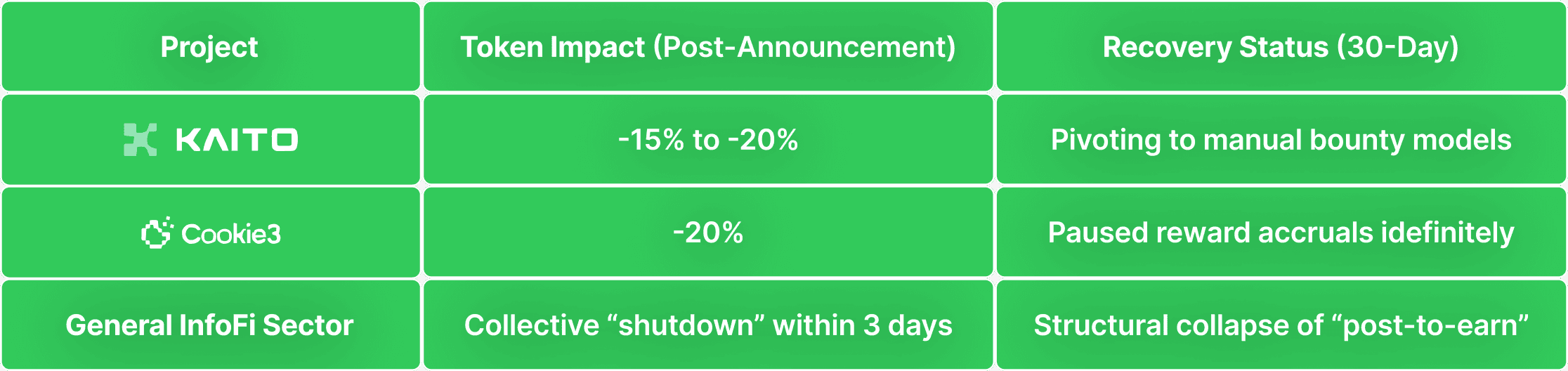
The collapse exposed a deep-seated reliance on centralized platforms and revealed the fragility of growth models built on shallow, easily gamed data. Investors and developers were forced to realize that "the more rewards there are, the faster the data can be gamed". This realization catalyzed a pivot toward infrastructure that could verify "real intent and retention" rather than just counting completions.
The Shift to Quality Over Volume
The post-InfoFi era is characterized by a "quality-over-volume". Quests are no longer judged by the raw number of participants but by their ability to move a user from "curiosity to first action, from first action to repeat usage, and from usage to meaningful contribution". This transition necessitated the development of stronger verification and credential layers to separate real human users from sophisticated bot farms. Galxe’s role in this transition is central, as it treats quests as long-term growth infrastructure rather than short-lived hype cycles.
Galxe Today: What It Actually Is?
In 2026, it’s no longer accurate to think of Galxe as “a questing tool.” It has evolved into a full stack growth engine and web3’s largest distribution layer, that connects tens of millions of users with thousands of ecosystems. The platform unifies onboarding, identity, incentives, and analytics for teams on multiple networks.
The Core Product Modules
The Galxe ecosystem operates through several interlocking modules, each serving a specific phase of the user lifecycle. These modules are designed to be "reusable growth rails" that teams can plug into at various points in their protocol’s development.
Galxe Quest: A programmable engine for both on-chain and off-chain tasks. It allows developers to create interactive, reward-based loyalty programs that connect them with a user base of over 36 million unique addresses. Quest's multi-chain capabilities mean ecosystems can integrate their own chains and launch rewards natively — with support spanning Ethereum, BNB Chain, Solana, Sui, Sei, and more, giving projects greater flexibility while delivering a network-native experience for users. Since January 2025, Quest's raffle mechanic (zkRaffles) has been powered by zero-knowledge technology, built in partnership with Succinct - ensuring winner selection is fully verifiable on-chain while significantly reducing gas costs
Galxe Passport and Score: These identity and reputation primitives provide the foundation for Sybil resistance. Passport functions as a secure, reusable identity solution where users verify their KYC (Know Your Customer) data once and receive a Soulbound Token (SBT) as proof of personhood. Score aggregates both on-chain behavioral data and off-chain signals — including social profiles, Galxe Quest participation, and more — while incorporating a humanity evaluation layer to deliver a comprehensive measure of user intent and authenticity.
Galxe Starboard: An analytics layer that measures real contribution impact. It tracks real-time social dynamics and on-chain activity, helping projects identify the right contributors who drive genuine narrative shaping and usage, rather than generic farmers.
Galxe Earndrop: An institutional-grade token distribution infrastructure built for high-pressure TGE moments. It supports claims across 11 major networks - Base, BNB Chain, Arbitrum, Sui, Ethereum, Polygon, Optimism, Gravity, Avalanche, and Solana - and has delivered $114M distributed, 2.3M claims processed, 100K simultaneous claims handled, and 10M visits, proving its reliability when it matters most. Instead of building custom claim contracts and frontends from scratch, teams plug into Earndrop, configure eligibility, vesting, and network coverage, and launch a fully branded claim experience. The UI and distribution logic are fully customizable, allowing projects to align token distribution with their tokenomics, compliance requirements, and marketing narrative - while keeping execution transparent, auditable, and scalable.
Gravity: Gravity underpins Galxe’s onchain infrastructure and is currently live in Alpha Mainnet, built on Arbitrum Orbit’s Nitro stack. It was introduced to address scalability constraints by consolidating high-volume, multi-chain ecosystem activity into a unified execution layer. Core interactions — including quests, loyalty points, and identity data — now settle directly on Gravity, improving efficiency and transparency, as evidenced by Arbitrum's published case study.
In parallel, the team is developing Gravity’s standalone Layer 1 architecture, including the Gravity SDK and Gravity Reth, a performance-optimized fork of Reth. Benchmarking has reached 1.5–1.9 gigagas per second, with contributions recognized by Georgios Konstantopoulos, General Partner & CTO at Paradigm, for strengthening the broader open-source Reth ecosystem
These are different faces of the same engine: once a project plugs into Galxe, it can reuse these rails across launches, ecosystem programs, and retention campaigns instead of spinning up one-off quests in isolation.
The Credential and Identity Backbone
Galxe's identity layer — built around Passport and Score — lets projects verify users based on their actual on-chain history rather than just wallet counts. This creates native Sybil resistance: credentials are earned through verifiable behavior, making it significantly harder for bots and fake accounts to game campaigns.
This infrastructure is powered through Business+, Galxe’s subscription layer for project owners, enabling seamless deployment and management at scale. In practice, Business+ is what turns a one-off quest into a continuously running growth system. Projects get detailed analytics on who completed what, automatic bot detection and exclusion, leaderboards that track genuine contributor activity over time, and an API to plug quest data into their own platforms. Advanced Sybil prevention is also available through Business+, adding an additional layer of protection against fraudulent or duplicate participation.
The result is a shared distribution network: rather than building audiences from scratch each time, projects tap into Galxe's existing user base, credential system, and discovery surfaces as a common layer.
As of now, the platform has issued 650K+ credentials, reflecting how widely this identity infrastructure has been adopted across the ecosystem.
Starboard: Aligning Incentives with Impact (Galxe’s Answer to Distribution)
Starboard is the layer that turns quests and campaigns into a ranked map of real contribution. The January crash exposed how fragile single-surface, X-only loops were: tools that rewarded any post around a hashtag, regardless of quality or downstream behavior, collapsed as soon as policy and API risk materialized. It tracks both social propagation and protocol-level behavior, lets projects define their own objectives (TVL, usage, referrals, education, etc.), and ranks contributors by how strongly they support those goals rather than by how often they post. By prioritizing verified, high-signal contributors over automated engagement, Starboard acts as a specialized distribution rail. This ensures that rewards are directed to users and KOLs who drive tangible network value through a data-driven dashboard that integrates directly with Galxe’s quest and identity rails.
Market Comparison: Galxe vs. TaskOn vs. Zealy vs. Layer3
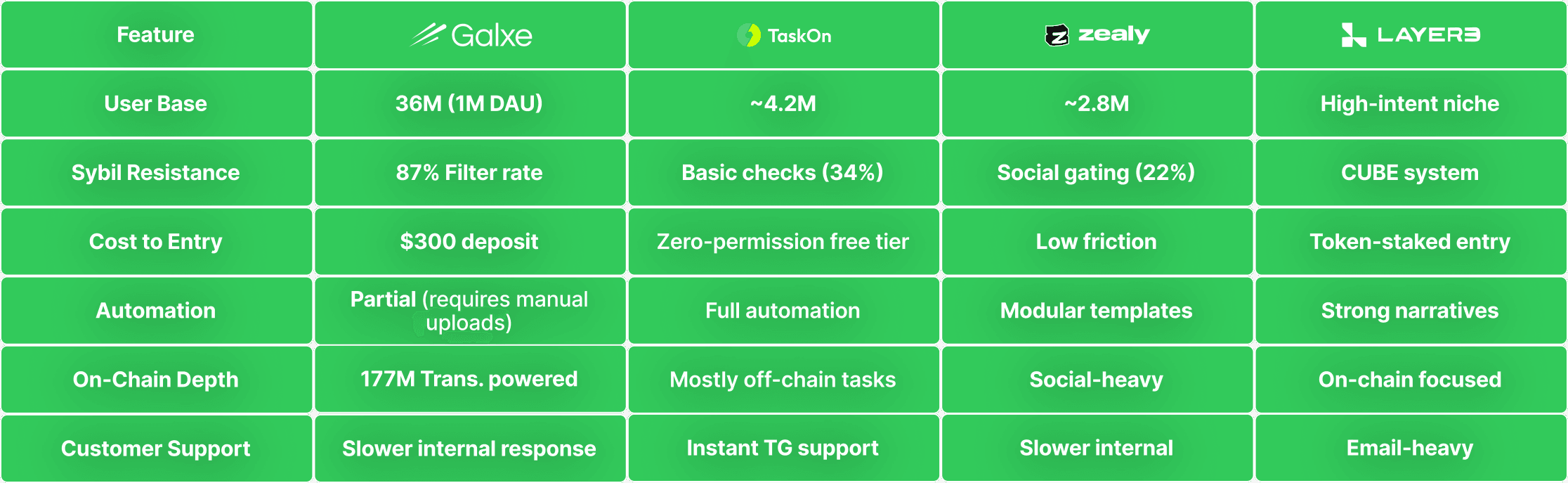
While Galxe commands the largest user base, it is not the optimal solution for every project. A strict, fact-driven comparison reveals that competitors have found success by addressing specific "frictions" inherent in the Galxe model.
Competitive Matrix: Performance and Friction
Where Galxe Loses: Frictions and Detractors
The research highlights several key areas where Galxe loses to its competitors:
Operational Complexity: Galxe has been criticized for being "cluttered" and having a product intelligence that is "somewhat lacking" compared to automated rivals. While the platform does offer a robust analytics suite — spanning Quest Performance Data, Leaderboard Insights, the Sybil Prevention Tool, Additional Gas Credit Subsidy, and GG Boost, and covering on-chain and off-chain data, real-time user behavior tracking, and campaign attribution. TaskOn, for instance, provides a more efficient experience through its "smart automation tools" and "instant replies," allowing projects to complete on-chain interactions in one stop within the site.
Labor and Time Costs: For example, on TaskOn, even after configuring a campaign and selecting winners, project teams must manually export the raffle results, review the list for accuracy, and then upload the winner data back into the system for distribution. This multi-step manual process introduces additional administrative burden, consumes valuable time, and increases the likelihood of errors — particularly in high-volume campaigns with thousands of participants. In contrast, Galxe eliminates these manual steps. Once a quest is configured and the raffle parameters are set, the platform automatically conducts the draw and distributes rewards to winners without any human intervention, enhancing operational efficiency and reducing administrative costs.
Financial Barrier: Galxe's usage cost is "the highest among task platforms". For early-stage projects or small/medium enterprises (SMEs), TaskOn "crushes" the competition by offering zero-permission automation that is especially suitable for cold starts.
Top-of-Funnel Noise: As of January 2026, Zealy maintains a lead in the "social coordination and human attention" layer, recording 3.29 million total visits compared to Galxe's 2.52 million. Zealy's architectural focus on recurring "Sprints" and deep social integration continues to drive the high-frequency retention loops necessary for capturing top-of-funnel awareness. Galxe also supports Sprints natively through its Advanced Points Management system, branded as Seasonal Leaderboards, enabling the same periodic engagement cycles, point resets, and structured competition mechanics. While the feature parity exists, Zealy's earlier entrenchment in the sprint-native workflow continues to give it an edge at the top of the funnel.
By 2026, more than 7,800 projects have used Galxe to power their growth campaigns, reinforcing its position as core infrastructure for Web3. Leading ecosystems such as Soneium, Movement Labs, Arbitrum, Linea, and Polygon are among its partners. In 2025, standout campaigns showcased its scale and flexibility: Soneium onboarded Web2-native creators through a multi-week journey across NFTs, SocialFi, and gaming; Sahara AI launched a tiered “Knowledge Drop” via Earndrop with structured vesting, improving retention over traditional token distributions; Dango activated 160,000+ users pre–Alpha Mainnet through OATs and raffles; and, alongside 0G, Galxe drove 2.5M+ quest engagements across two competitive seasons. Additional large-scale activations included Tanssi’s $1.7M pre-mainnet token distribution and Irys’s 2.7M-participant testnet campaign. Networks such as Avalanche, Mantle Network, Karrier One, Warden Protocol, Ducat Protocol, Forte Protocol, and Gopher further underscore Galxe’s broad adoption and impact across the ecosystem.
Lifecycle Engagement: The Three-Phase Growth Playbook
Founders successfully leveraging Galxe in 2026 typically follow a structured lifecycle approach, moving through three distinct phases of activation, validation, and distribution.
Phase 1: Awareness and Early Adoption
Early-stage teams focus on building visibility and attracting "high-intent early adopters" without a live token. Arbitrum’s Odyssey campaign remains a gold standard, where weekly quests guided users through ecosystem DeFi protocols, resulting in 1.7 million NFTs minted by over 623,000 unique users.
Phase 2: Testnet and Technical Validation
As projects transition to testnets (e.g., Berachain or Linea), the priority shifts to technical stress-testing. Linea’s "Voyage" campaign attracted 5.6 million wallets and generated 50 million transactions, using Galxe Passport to enforce Sybil resistance so that testnet metrics reflected real usage rather than bot activity.
Phase 3: Mainnet, TGE, and Scalable Distribution
At the TGE phase, teams must manage the complexity of token distribution. Solayer used Galxe Earndrop for its LAYER airdrop, allowing the infrastructure to handle traffic spikes and enforce eligibility criteria while the team focused on distribution logic. Sahara AI took a different path, rather than plugging into a standard claim flow, they used Earndrop to design a fully customized experience from start to finish, with their own branding, contributor tiers, eligibility logic, and vesting structure built around their specific tokenomics and community narrative. The Knowledge Drop represented 5% of total $SAHARA supply, distributed across three contributor categories, with 64.25% of the total supply dedicated to community and ecosystem initiatives overall. The two cases show the range Earndrop covers: fast and reliable for teams under pressure, fully configurable for teams where the distribution itself carries a message..
The Galxe playbook: quests that actually survive the post-InfoFi era
In the post‑InfoFi landscape, Galxe operates as growth infrastructure rather than a standalone quest interface. Each campaign starts with a single core outcome:
Activate new wallets (zero to first on‑chain action)
Retain past users (bring them back into the product)
Deepen existing users’ engagement (liquidity, referrals, content, governance, loyalty point)
That single choice defines messaging, CTAs, reward design, and modules. The core rule: build around the product, not the feed. Social actions still help discovery, but they orbit meaningful touch-points wallet connection, feature use, on‑chain activity, partner integration. Every step should move participants toward the desired outcome.
With credentials and identity verification, Galxe enables tailored flows to simple paths for new users, higher‑effort tasks for returning ones, and advanced tracks for contributors. Over short 2–4 week windows, this creates natural progression for first touch, deeper use, sustained action without juggling multiple tools.
Underneath, you assume farming is there by default and design against it. On Galxe, that means chaining several tasks, mixing social, on-chain, and credential checks (including custom credentials built around your project's specific smart contract logic and on-chain behavior), avoiding "one click = full reward," and using the available Sybil filters so that rewards slowly drift toward wallets with human-like, repeated behavior instead of fresh bots. After each wave, analyze who actually activated, retained, or contributed and roll those users into next‑stage programs like beta testing or ecosystem roles.
What this means for teams using Galxe?
Seen through this lens, Galxe becomes less of a one-off campaign tool and more of a timing layer in your roadmap. You plug it in at moments where you need coordinated, on-chain movement:
ahead of launch or testnet, to structure discovery and early access with some Sybil protection baked in;
around TGE or mainnet, to turn the narrative spike into real first actions instead of just chart screenshots and noise;
during ecosystem pushes and partner seasons, to route users between you and collaborators on one shared stack;
in planned retention waves, to re-wake your own user base around new features, chains, or incentives.
What no longer fits the market, or Galxe’s own direction — is using it for pure engagement bait (only likes and reposts), isolated “one and done” quests that never connect to anything, or reward logic that hinges on a single trivial signal. Those are the patterns that blew up with InfoFi and that credential-driven, infrastructure-style systems are explicitly moving away from.
In practical terms, success on Galxe is easy to read once you know what you're looking for: did more wallets reach the on-chain milestone you actually care about; did a meaningful slice of them come back in the following weeks without needing a new bribe; and did a recognizable core of real contributors emerge that you can see, name, and build with? The depth of that read depends on what tools you have access to. Galxe Business+ offers tiered plans that let teams choose the level of infrastructure that fits their current stage — from basic quest analytics and bot identification at the entry level, through to advanced Sybil prevention and full Starboard access as programs scale, and fully customized solutions for larger ecosystems. The plan a team is on shapes how much signal they can extract from each wave and how precisely they can act on it.
Conclusion: The Strategic Reset of Web3 Growth
The 2026 market correction effectively ended the era of spam and forced a transition to high-signal, infrastructure-led growth. Galxe has positioned itself as the leader of this transition, not merely as a quest platform, but as a distribution layer anchored by the Gravity blockchain and the G token ecosystem.
While Galxe commands a massive network of 36 million users and over 7,800 partners, this scale comes with "highest usage costs" and operational frictions that have allowed TaskOn and Zealy to flourish in the SME and social-first sectors. The future of Web3 growth is likely a hybrid model, where projects use lower-cost automated tools for initial awareness and Galxe’s robust identity and distribution rails for high-value activation and token events.
For professional analysts and protocol founders, the takeaway is clear: success no longer depends on "getting people to do tasks," but on proving those users are real, keeping them engaged through verified reputation, and allowing their contributions to compound within a secure, high-performance infrastructure. Galxe’s unified stack is one of the few growth systems built to meet these rigorous standards in the post-InfoFi world.
In the end, the InfoFi crash didn’t kill quests—it killed low-integrity mechanics that treated clicks and posts as proof of success. Quests are still very much alive because they’re a simple, powerful behavioral rail; they just have to be wired to real outcomes now: activation, retention, and contribution instead of empty participation.
This report reflects independent analysis based on sources available at the time of writing and does not constitute investment, legal, or tax advice. Readers should conduct their own due diligence (DYOR) before making any decisions.
Reference list:
Galxe. (n.d.). Earndrop. Retrieved February 28, 2026, from https://www.galxe.com/earndrop
Galxe. (n.d.). Score. Retrieved February 28, 2026, from https://www.galxe.com/score
Galxe. (n.d.). Business+ onboarding. Retrieved February 28, 2026, from https://dashboard.galxe.com/onboard
Galxe. (n.d). Galxe 2025: Year in review. https://www.galxe.com/blog/galxe-2025-year-in-review
Galxe Help Center. (n.d). Advanced points management. Retrieved February 28, 2026, from https://help.galxe.com/en/articles/9733873-advanced-points-management
Galxe Help Center. (n.d). Custom credentials: Smart contract queries. Retrieved February 28, 2026, from https://help.galxe.com/en/articles/8673251-custom-credentials-smart-contract-queries
Galxe Help Center. (n.d). Galxe luck-based token reward. Retrieved February 28, 2026, from https://help.galxe.com/en/articles/11872447-galxe-luck-based-token-rewarda
Kulkarni, K. (2025). Galxe brings the power of ZK to millions with Succinct. Succinct. https://blog.succinct.xyz/case-studies/succinct-galxe/
Messari. (2026). Galxe: The Web3 growth engine [Research report]. https://messari.io/report/galxe-the-web3-growth-engine
The Block. (2026). How Galxe Business+ helps teams scale at every stage. Retrieved February 28, 2026, from https://www.theblock.co/post/388952/how-galxe-business-helps-teams-scale-at-every-stage
Binance Square. (2026, January 15). X API ban kills Kaito and InfoFi crypto projects: The death of AI slop? https://www.binance.com/en/square/post/35154405573802
Galxe. (2026, January 13). Galxe 2025: Year in review. https://www.galxe.com/blog/galxe-2025-year-in-review
Gravity. (2025). Gravity Reth. https://docs.gravity.xyz/research/greth
Sahara AI. (2025, June 20). Claim your $SAHARA: Knowledge Drop distribution details for early Sahara AI contributors. https://saharaai.com/blog/knowledge-drop
The Block. (2024, October 4). How Galxe is bringing smarter community building to Web3. https://www.theblock.co/post/340650/how-galxe-is-bringing-smarter-community-building-to-web3
The Economic Times. (2026, January 15). Crypto chaos hits X: KAITO token drops 20% and NFT prices fall after Elon Musk's platform blocks InfoFi apps. https://m.economictimes.com/news/international/us/crypto-chaos-hits-x-kaito-token-drops-20-and-nft-prices-fall-after-elon-musks-platform-blocks-infofi-apps-what-does-it-mean-for-investors/articleshow/126551034.cms
Semrush. (2026). Zealy.io January 2026 traffic sales. https://www.semrush.com/blog/ai-seo-statistics/
Semrush. (2026). Galxe.com January 2026 traffic sales. https://www.semrush.com/website/galxe.com/overview/